top of page
Design IV
Corporate Apartment
Housing on Long Island
Affordable Living Space for the Next Generation of Workers
By: Valentina Tomaylla & Margaret Adams
Project Overview
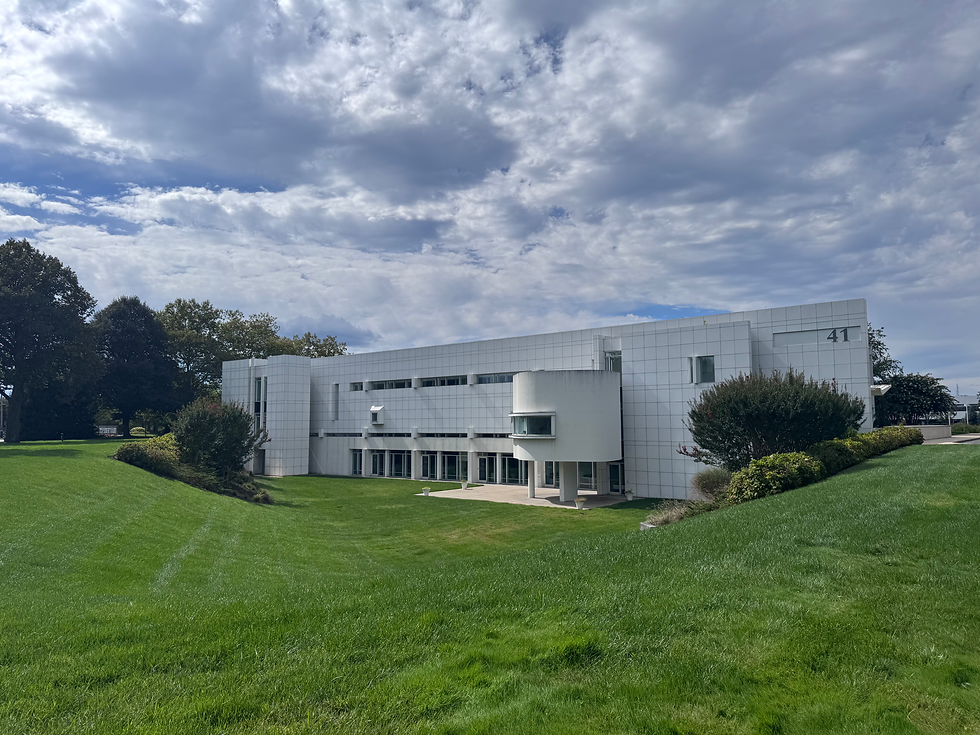
Long Island faces an escalating workforce shortage closely linked to its lack of affordable housing. Young professionals, often burdened by student debt and starting salaries—are increasingly unable to live locally, limiting the regional talent pipeline. To address this challenge, the 58,000 SF former Swissair Headquarters at 41 Pinelawn Road, Melville, NY, presents a strategic opportunity for corporate-sponsored incubator housing.The building’s award-winning design (AIA New York 1998 Design Award) and adaptable structure make it an ideal candidate for conversion into affordable, early-career residential units. Providing attainable housing at this location would allow emerging professionals to establish a foothold on Long Island rather than relocating elsewhere. Research consistently shows that once workers put down roots, they remain—strengthening the region’s long-term economic vitality, leadership pipeline, and overall resilience.By transforming 41 Pinelawn Road into incubator housing, Long Island can directly support its future workforce while leveraging an architecturally significant asset for contemporary needs.
Site Location:
41 Pinelawn Rd, Melville, NY 11747
Key Stats:
-
Site Area: 58,000 ft²
-
Building Size: 15,458 sq ft
-
Program: Corporate-sponsored incubator housing
-
Tools Used: AutoCAD, Revit, Lumion, Procreate
Approach
For this project, we developed three preliminary design studies. Guided by Peter Rowe’s heuristic strategies, we used them as the foundation for our spatial reasoning and strategic decision-making. Through this framework, we explored multiple approaches to address the design problem. Our design process followed three key steps, Condition, Action, and Intent, which we applied to justify and articulate the reasoning behind each study.
Our final idea emerged from a strong focus on the building’s environmental relationships, particularly its interaction with sunlight. Through our step-by-step form development process, we explored how the massing could respond to the sun’s path, maximize natural light, and integrate sustainable systems. By analyzing orientation, carving volumes for daylight, and shaping angled façades, we discovered that the design could naturally improve energy performance while enhancing interior spatial quality. This led us to integrate solar panels, skylights, and other passive strategies directly into the building’s form.
Ultimately, we chose this concept because it combines sustainability with architectural expression. The building doesn’t just use environmental systems it is shaped by them.
Existing Site


Elevations
Sections


bottom of page